Onur Sahin
Rendering Engineer
I build real-time renderers for games. Professionally I work on Unreal Engine rendering for AAA titles, including ray-traced hair lighting on MindsEye. In my own time I build VulkanGraphics, a Vulkan engine where I try new techniques.
Experience in Industry
Graphics Programmer since April 2023: engine-level rendering in Unreal Engine 4 and 5 for AAA games.
Shipped games
- MindsEye: improved its hair lighting with ray tracing, cutting light bleed from non-shadow-casting lights and overexposure.
NVIDIA DLSS
- Restored Frame Generation under scaled viewports. The HUD-less buffer was tagged before Unreal’s spatial upscaler ran; a post-upscale hook now re-tags it at final resolution.
- Removed Ray Reconstruction speckling on rough metals. Lumen’s downsampled reflections left fixed-pattern noise that the denoiser kept as detail. Full-resolution sparse tracing, a random 25% of pixels with the rest reconstructed, fixed it for about 40 MB at native 4K.
Virtual shadow maps
- Shadow invalidation for dynamic casters that scales with camera distance, and screen-size culling of casters too small to matter.
- Fixed self-shadowing on meshes with world position offset: a per-pixel rejection mask compares contact shadows against VSM. Shipped engine-wide.
Rendering systems
- Owned a custom shadow pass end to end: resources, scheduling, shaders, RHI management and a Blueprint API for artists.
- Custom shaders and material nodes; deferred, forward and translucent paths; RDG; Niagara shaders; ports across engine upgrades.
Display and graphics settings
- Runtime multi-monitor switching (viewport move, resolution sync, fullscreen, DPI), built before Unreal supported it.
- Graphics settings from menu to engine: scalability, ray tracing, HDR, motion blur, depth of field, FOV and resolution.
VulkanGraphics
My Vulkan engine in C++. It began as my MSc dissertation and is where I try new rendering techniques.
A thin layer over Vulkan for descriptor sets, swapchains, pipelines, render passes and mipmap generation. On top of it: glTF model loading, PBR shading, skyboxes, and particles driven by simplex and curl noise.
Each experiment below is a mode or pass in the engine, with its source on GitHub.
Experiments
Volumetric clouds
A cloud layer ray marched in a compute shader, every frame.
Every pixel marches through a slab of fractal noise in fixed steps. The first step is offset by blue noise, which trades banding for fine grain, and the march stops as soon as the pixel is 99% opaque.
Lighting costs one extra density lookup per step: density here minus density a short way towards the sun. That gives bright rims and darker undersides without marching a second ray.
Path-traced Cornell box
A progressive reference path tracer in a Vulkan compute shader.
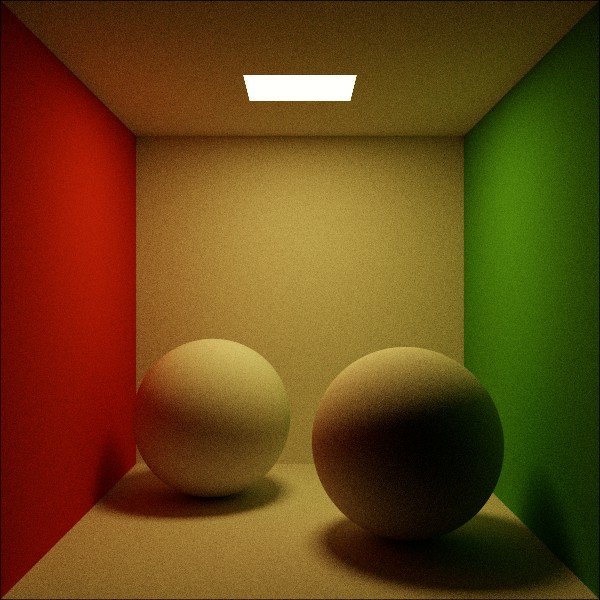
Drag or use arrow keys to orbit
Each frame adds one sample per pixel to a running average. Surfaces are Lambertian and bounces are cosine weighted, so the weight a bounce carries reduces to the surface albedo.
The bounce loop is written to move into a hardware ray tracing pipeline (raygen, closest-hit and miss shaders), with this version kept as the reference both should converge to.

PBR Sponza
PBR materials, shadows from the sun and every torch, and an HDR post-processing chain.
Materials come from glTF: albedo, normal and roughness/metallic maps, shaded with a Cook–Torrance BRDF. The sun casts a PCF-filtered shadow map. Each torch is a point light with its own cube shadow map, drawn in a single pass by a geometry shader that sends every triangle to all six faces.
Everything renders into HDR targets, then runs through the passes below before reaching the swapchain.
- Shadow mapsSun with PCF, torches as cube maps
- PBR lightingCook–Torrance into an HDR target
- BloomBright pass, blurred down and up
- Depth of fieldBokeh, gathered in rings from depth
- CompositeScene, bloom and clouds to the swapchain
AnorEngine
My first engine: a 3D and 2D OpenGL renderer with an ImGui editor.
Written in C++ to learn how an engine fits together before moving to Vulkan: a renderer, a scene that saves to disk, and an editor to build scenes in.
About Me
Five years of C++, three of them on rendering for AAA games.
I like the whole frame: how light moves through a scene, how shadows hold up, how a denoiser or an upscaler sees the image, and the post-processing that ties it together. At work that happens inside Unreal Engine; at home it happens in my own Vulkan engine.
Education
- MSc Games Programming
- Kingston University, 2021–2023. Distinction.
- BSc Software Engineering
- Atılım University, 2016–2020. High honours, GPA 3.77/4.00.